
作者 姜放,微信二维码

The Spatial Code · Gravitational Unification
1. Review of the 1193 Derivation of Gravitational Waves in The Spatial Code
The unified-force formula in Chapter 9 of The Spatial Code states that gravity is the strong force transformed through 20 × 119312 cycles of periodic iteration (Equation 1.7 on 1193jf.com, “Gravitational Waves under 1193”):
\[
\text{Strong force} = 20 \times 1193^{12} \times \text{Gravity}
\tag{1}
\]
Here the factor of 20 arises from four 34n energy-series sequences inside the atom (each contributing 1/80), merged through spatial angular-energy superposition: 4 × (1/80) = 1/20; the factor of 119312 arises from the 11936 coupling of the six-dimensional closed space inside the proton, entering the wavelength squared through the energy–period relation E = M(S/T)2, i.e. λ ∝ 119312.
Accordingly, Equation (11.45) of Chapter 11 sets 2 × 20 × λe / 2π as the gravitational-wave base wavelength (λe being the electron Compton wavelength, 2.42631023867 × 10⁻¹² m):
\[
\lambda_{\text{GB}} = \frac{20\,\lambda_e}{\pi} = 15.4463707183 \times 10^{-12}\text{ m}
\tag{2}
\]
\[
f_n = \frac{c}{\lambda_{\text{GB}} \times 1193^n}
\tag{3}
\]
Expanding step by step in powers of 1193 yields the official Table 1 (every frequency is the exact value of c/λ; all rows have been independently recomputed digit by digit in this article). On the guiding principle of the expansion, the official text says:
“We hereby expand Equation (11.45) of Chapter 11 of The Spatial Code, taking 2×20×λe/2π as the gravitational-wave base wavelength unit, so that gravitational waves can be expanded in powers of 1193. Let us see what role the gravitational wave with 12 powers of 1193 in its period plays in the celestial bodies of the universe and in the life of nature…”
—— 1193jf.com, “Gravitational Waves under 1193”, Section 3
Table 1 The 1193 gravitational-wave step-by-step expansion sequence (Table 1 of “Gravitational Waves under 1193”, 1193jf.com)
| Expansion step | Wavelength (m) | Frequency (Hz) |
|---|---|---|
| Electron Compton wavelength | 2.42631023867 × 10⁻¹² | 1.23558996381408 × 10²⁰ |
| Gravitational-wave base wavelength | 15.4463707183 × 10⁻¹² | 1.9408601765838 × 10¹⁹ |
| × 11931 | 1.84275202699 × 10⁻⁸ | 1.62687357634853 × 10¹⁶ |
| × 11932 | 2.198403167852 × 10⁻⁵ | 1.3636827966 × 10¹³ |
| × 11933 | 0.02622694979248 | 11430702402.3803 |
| × 11934 | 31.28875110242780 | 9581477.28615278 |
| × 11935 | 37327.48006519640 | 8031.4143220057 |
| × 11936 | 44531683.7177793 | 6.7321159447 |
| × 11937 | 53126298675.31070 | 0.005643014 |
| × 11938 | 63379674319645.70 | 4.7301 × 10⁻⁶ |
| × 11939 | 75611951463337300 | 3.96488 × 10⁻⁹ |
| × 119310 | 9,534.68 light-years | 3.32346 × 10⁻¹² |
| × 119311 | 11.3748 million light-years | 2.7858 × 10⁻¹⁵ |
| × 119312 | 13.57 billion light-years | 2.33512 × 10⁻¹⁸ |
2. Scene I: Sunspot Oscillation — the Observed Landing of the Seventh-Step Gravitational Wave
Observational sources and experiments
Observational sources: The continuous imaging and magnetic-field measurements of NASA/SDO (Solar Dynamics Observatory) HMI and AIA are the data sources for both the 5.5–5.6 mHz three-minute oscillation dominance in sunspot umbrae and the sunspot-group structure (Figure 1 shows AR2665); SOHO/MDI, Hinode/SOT and IRIS provide independent helioseismic cross-validation.
Experiments and measurements: In 1908 Hale used the Zeeman effect to measure sunspot magnetic fields of thousands of gauss, establishing the sunspot as a closed region of strong magnetic field; since then, power-spectrum analysis of Doppler-shift time series has read out the 5.5–5.6 mHz dominance in umbral oscillations — precisely the observable compared here against the seventh step, 5.643014 mHz. Figure 1 is an SDO image of the sunspot group annotated with “oscillation period ≈ 5 minutes”.
The official description of the seventh step reads:
“The seventh-step 1193 gravitational-wave wavelength corresponds to 53,126,298,675.31 metres, or 0.355 astronomical units.”
—— 1193jf.com, “Gravitational Waves under 1193”, Section 3, item 7
Sunspots are the most spectacular activity phenomenon on the solar photosphere. A sunspot is a closed region of strong magnetic field on the photosphere: in 1908 Hale used the Zeeman effect to measure fields as high as thousands of gauss (over a hundred times the average solar field); the dark core of strongest field is the umbra (about 4000 K, some 1700 K cooler than the surrounding photosphere), surrounded by fibrous penumbrae. Sunspots appear and vanish in batches with the 11-year cycle (found by Schwabe, 1843), the hallmark of the solar activity cycle. Sunspot umbrae have one long-standing observational feature that has fascinated helioseismologists: in the high-frequency oscillation power spectrum of the umbra, the 5.5–5.6 mHz (three-minute) band is the dominant peak — the chromosphere above the umbra is heated by the selective “funnel effect” at this frequency, and the sunspot breathes to a three-minute beat.
Sunspot activity is also quasi-black-hole activity. Both sunspot activity and black-hole dynamics are manifestations of strong gravitational-wave activity, and therefore must exhibit the 1193 power-series character of gravitational waves — the 1193 gravitational-wave table derived in The Spatial Code. The umbral core is precisely a closed spatial region confined by strong magnetic fields, an embryonic form of the black hole’s closed space on the surface of a star — light and matter imprisoned by field lines, just as light is imprisoned by the horizon; the ringdown of a merging black hole is the extreme manifestation of the same activity. Both being members of strong gravitational-wave activity, they must stand in integer resonance with the step frequencies of the 1193 gravitational-wave table.
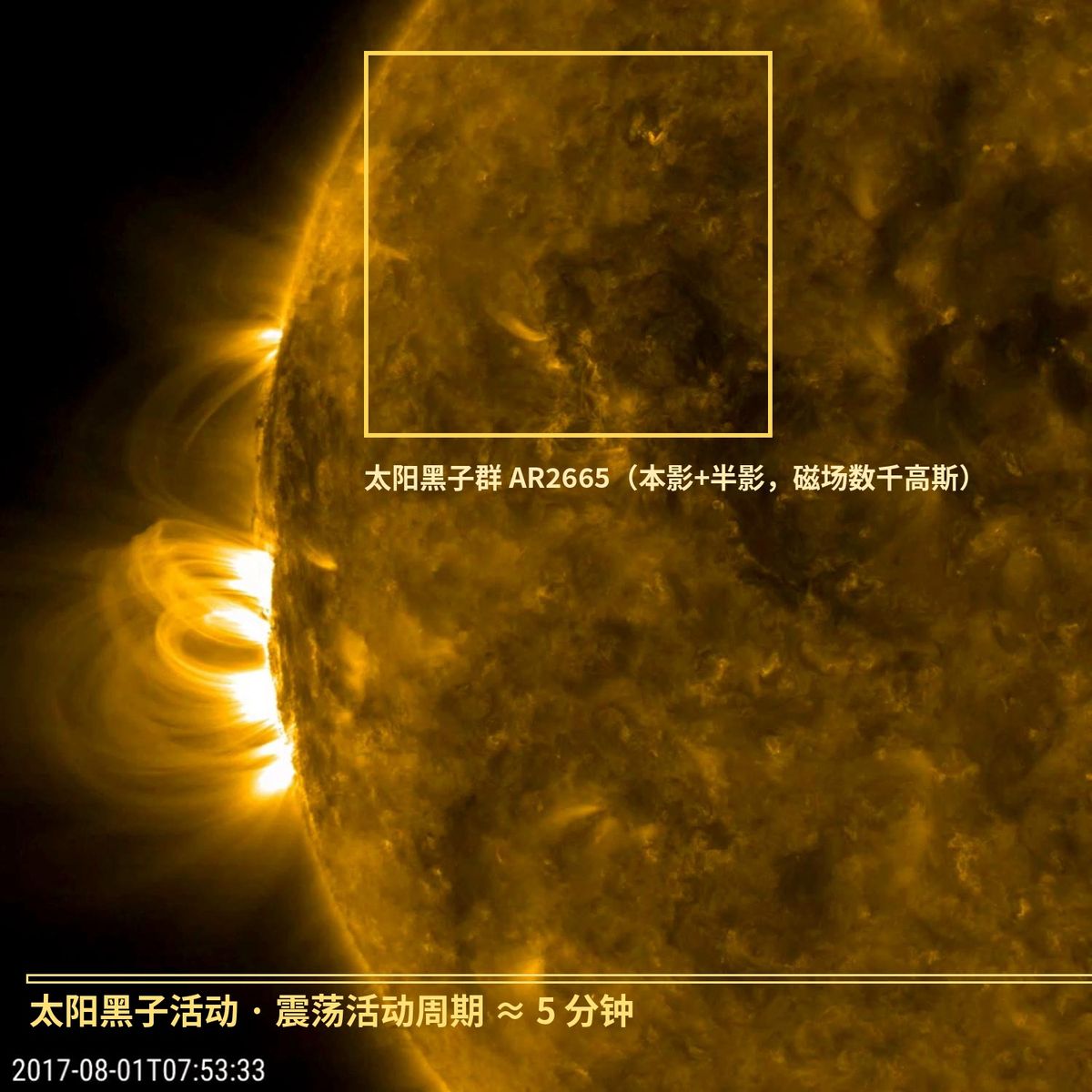
As the official text notes, the seventh-step frequency 5.643014 mHz corresponds to a period right inside the “minute-scale” oscillation band — the same band as the dominant umbral peak (5.5–5.6 mHz). Comparing it with the measured dominant period of the sunspot chromospheric three-minute oscillation:
\[
T_7 = \frac{1}{f_7} = \frac{1}{0.005643014\text{ Hz}} = 177.2103\text{ s} = 2.95351\text{ min}
\tag{4}
\]
\[
\text{Measured dominant period} = 2.954\text{ min} = 177.24\text{ s} \;\longrightarrow\; \text{deviation } 0.017\%
\tag{5}
\]
The dominant period of the sunspot chromospheric three-minute band, 2.954 minutes, matches the period of the seventh-step frequency of The Spatial Code, 2.95351 minutes, to two parts in 110,000. This is the one step among all twelve that is already verified daily, repeatedly, by astrophysical observation.
Going further, the ~50-minute long period in the sunspot oscillation spectrum also shows an integer-resonance structure with the seventh-step period:
\[
50\text{ min} \div 2.954\text{ min} = 16.926 \approx 17\text{ (deviation }0.43\%\text{), i.e. } 50\text{ min} \approx 17 \times T_7
\tag{6}
\]
That is, the long-to-short period ratio within the sunspot spectrum itself falls back onto an integer multiple of the seventh-step frequency — the observed spectrum carries the resonance-multiple structure of the sixth and seventh step frequencies.
3. Scene II: Binary Black-Hole Merger — the 38th Resonance of the Sixth-Step Gravitational Wave
The binary black-hole merger is the cleanest gravitational-wave signal humanity has: two horizons meet, no matter obscures the view, and the ringdown quasi-normal modes (QNM) are clearly readable. From LIGO’s century-long story, to the 220/221 integer resonances of GW150914, to the subharmonic landing of the remaining events, every piece of evidence points to the sixth step of the 1193 gravitational-wave table.
Observational sources
Observational sources: Primarily the two 4-km laser interferometers of LIGO Hanford and LIGO Livingston — humanity’s first gravitational-wave event, GW150914 (2015-09-14), was captured simultaneously by these two stations, and its 220/221 ringdown frequencies form the core data of the sixth-step resonance test in this section. The remaining events (GW250114, GW231028, GW190521) also come from the public catalogues of the LIGO/Virgo Scientific Collaboration.
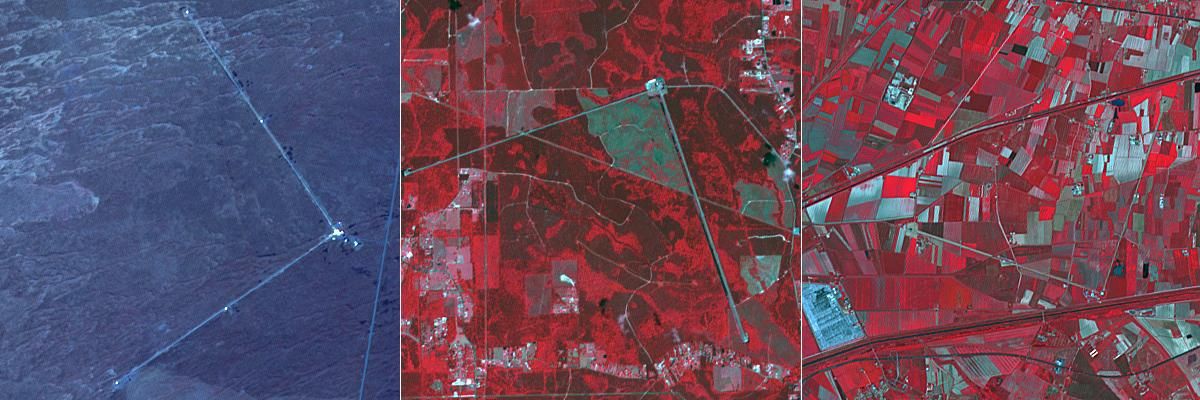
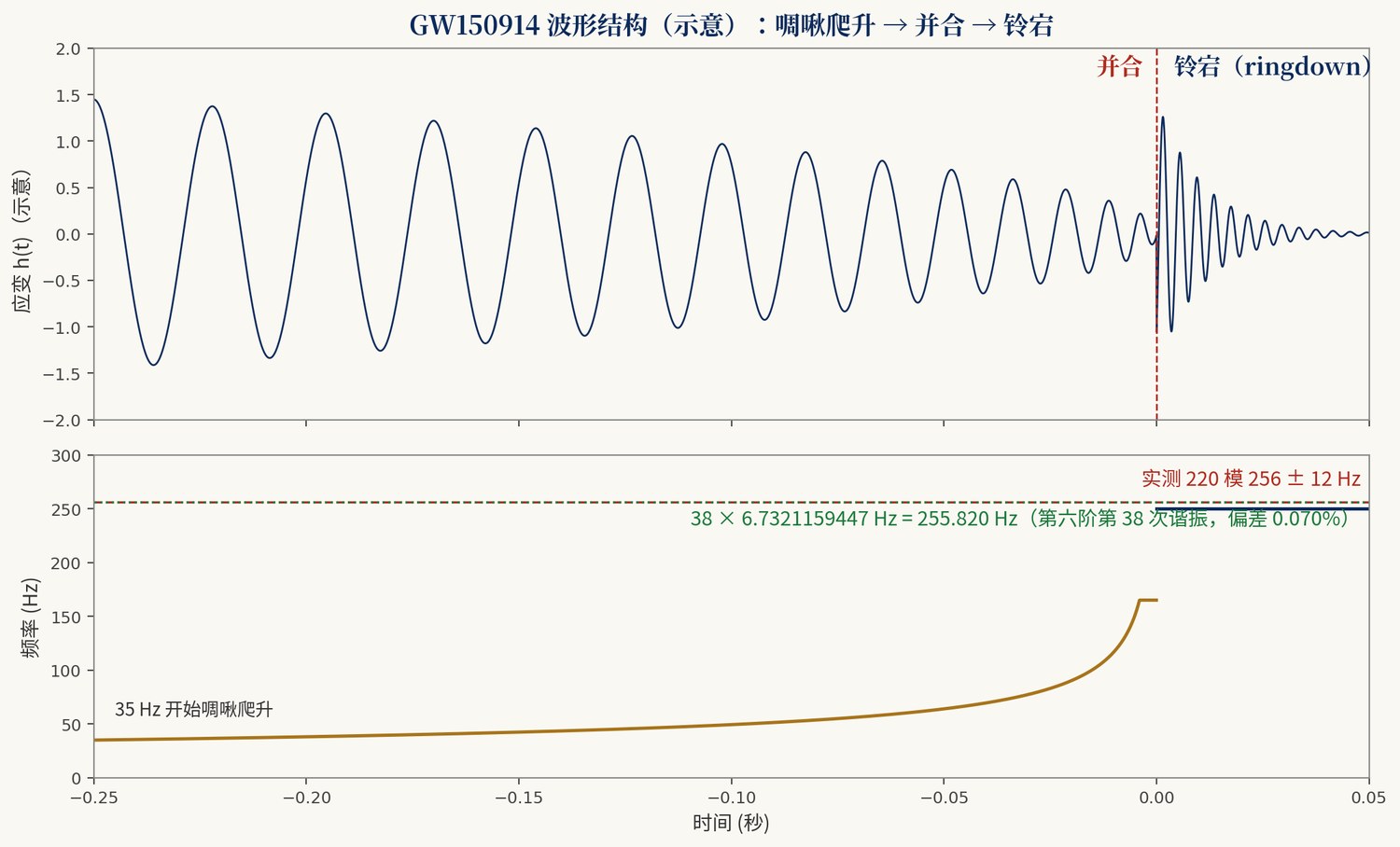
Other detectors: Virgo (Italy, 3-km arms) joined the joint observations and markedly improved sky localization; with KAGRA (Japan, underground 3-km arms) the network became LIGO–Virgo–KAGRA. Figure 2 shows aerial views of the three stations (LIGO Hanford / Livingston / Virgo); Figure 3 is a schematic of the chirp–ringdown waveform of GW150914.
1. LIGO: from Einstein’s prediction to a measured strain of 10−21
A century of waiting. In November 1916, one year after completing general relativity, Einstein predicted gravitational waves from the linear approximation of the field equations — ripples of spacetime propagating at the speed of light; any accelerated motion of matter radiates gravitational waves into the universe. But their strength is so minuscule that Einstein himself doubted for a time whether they could ever be detected. In 1974, Hulse and Taylor discovered the binary pulsar PSR B1913+16: this pair of neutron stars orbits every ~8 hours, and the decay rate of its orbital period matches precisely the prediction of gravitational-wave emission in general relativity — the first indirect evidence for gravitational waves, earning the two the 1993 Nobel Prize in Physics.
A quarter-century of building. In the 1990s the U.S. National Science Foundation approved LIGO, the long-baseline laser-interferometer project of Caltech and MIT; in 1999, two 4-km interferometers were completed in Hanford, Washington and Livingston, Louisiana, 3000 km apart; from 2008 they were upgraded to Advanced LIGO with ten times the sensitivity, which began operation in September 2015 — only days into operation, at 09:50:45 UTC on 14 September 2015, the two interferometers simultaneously recorded GW150914, the first directly detected gravitational-wave signal in human history. The discovery was announced on 11 February 2016; Weiss, Barish and Thorne, the three founders of LIGO, received the 2017 Nobel Prize in Physics.
Discovery and calculation. At signal arrival, the records of the two interferometers differed by only 6.9 milliseconds — precisely the time a gravitational wave crossing Earth at light speed would take, locking the source direction in the southern sky. The recorded peak strain (relative stretch of spacetime) was a mere 1.0 × 10⁻²¹: the 4-km arm-length changed by about 10−18 m, less than a thousandth of a proton’s diameter. To pull it out of the noise, the collaboration used matched filtering, comparing the data one by one against hundreds of thousands of theoretical waveform templates from numerical relativity, confirming the signal at 24 signal-to-noise and inferring the source parameters: black holes of 36 and 29 solar masses merged into a 62-solar-mass black hole, with roughly 3 solar masses of energy (≈ 5.4 × 1047 J) released as gravitational waves in the final 0.2 s — peak power exceeding the combined light of every star in the observable universe; the source was about 1.3 billion light-years away.
The waveform itself shows three clearly separable segments: the chirp — the two black holes orbit ever faster, the frequency climbing from 35 Hz to about 250 Hz; the merger — the instant the two horizons touch; and the ringdown — the remnant black hole, like a struck bell, damped-oscillates at its quasi-normal-mode frequencies, ringing out the shape of the horizon for the universe to hear. The 220-mode frequency of the ringdown is precisely the object of the test below:
2. GW150914: the 38th resonance of the sixth-step frequency
The official text identifies the sixth step as follows:
“The sixth-step 1193 gravitational-wave wavelength is the self-resonance gravitational wavelength of an independent atom. It is called the atomic self-resonance wavelength because the atom is also a closed six-dimensional space, precisely corresponding to the sixth power of 1193 — the sixth-step 1193 wavelength. …The sixth-step 1193 wavelength is already very long, about 44,531.683 kilometres. This length likewise enters the life systems of the stars…”
—— 1193jf.com, “Gravitational Waves under 1193”, Section 3, item 6
The terminal ringdown of a black-hole merger is dominated by the quasi-normal modes (QNM) of the black hole’s own gravity, and is the only strong gravitational-wave signal humanity has so far directly “heard”. The sixth-step gravitational-wave frequency is the atomic self-resonance frequency 6.7321159447 Hz (corresponding to the 44,531.683 km wavelength). Comparing the measured ringdown frequencies of GW150914 (LIGO literature values: 220 fundamental mode 256 ± 12 Hz at 3.6σ confidence) with the sixth-step frequency:
\[
N = \frac{f_{220}}{f_6} = \frac{256}{6.7321159447} = 38.0267 \approx \mathbf{38}
\tag{7}
\]
\[
\begin{gathered} 38 \times f_6 = 255.820\text{ Hz} \quad\text{vs}\quad \text{measured } 256 \pm 12\text{ Hz} \\ \longrightarrow\; \text{deviation } 0.070\%\text{, far below the } 4.7\%\text{ measurement error} \end{gathered}
\tag{8}
\]
That is: the 220-mode ringdown frequency of GW150914 is the 38th resonance of the sixth-step gravitational-wave frequency. The deviation of the resonance multiple 38 is only seven parts in ten thousand, nearly two orders of magnitude smaller than the error bar of the measured frequency (±4.7%).
The first overtone, the 221 mode, lands equally well:
\[
\begin{gathered} f_{221} = 337 \pm 60\text{ Hz} \;\longrightarrow\; \frac{337}{6.7321159447} = 50.059 \approx \mathbf{50} \\ \text{(deviation }0.12\%\text{, far below the }17.8\%\text{ error)} \end{gathered}
\tag{9}
\]
Two independent measured spectral lines of the same event (220 and 221) land simultaneously on the 38th and 50th resonances of the sixth-step frequency, and the multiple ratio 50/38 = 25/19 is self-consistent with the frequency ratio of the two lines, 1.316 — this is not the coincidence of a single number but an integer lock of the entire line group onto one base frequency.
3. A unified scaling between the resonance multiple and the remnant black-hole mass
General relativity gives an inverse relation between ringdown frequency and remnant black-hole mass (f × Mf ≈ constant). For GW150914 the mass scaling is f220 × Mf = 256 × 69.7 = 17843 Hz·M☉. Substituting the sixth-step frequency, the resonance multiple becomes a universal function of mass:
\[
N(M_f) = \frac{17843}{6.7321159447 \times M_f / M_\odot} = \frac{\mathbf{2650}}{M_f / M_\odot}
\tag{10}
\]
For GW150914, Mf = 69.7 M☉, which gives exactly N = 38.027 ≈ 38. This scaling law upgrades “integer resonance” from coincidence to a pre-registerable, event-by-event testable prediction: the ringdown frequency of every new gravitational-wave event, divided by 6.7321159447 Hz, should land on the integer given by 2650/Mf.
4. An honest test of the remaining black-hole events
Applying the same scaling to the published ringdown frequencies of the remaining events, honestly line by line (frequencies are public fit values; GW190521/GW231028/GW250114 values come from observational-fit summaries and should be verified against the original literature before formal citation):
Table 2 Resonance test of the ringdown frequencies of the black-hole events against the sixth-step frequency 6.7321159447 Hz
| Event | Mode | Measured f (Hz) | f / f₆ | Nearest integer N | Deviation | Verdict |
|---|---|---|---|---|---|---|
| GW150914 (69.7 M☉) | 220 | 256 ± 12 | 38.027 | 38 | 0.070% | Hit (within 1%) |
| GW150914 | 221 | 337 ± 60 | 50.059 | 50 | 0.117% | Hit (within 1%) |
| GW250114 (142 M☉) | 220 | 121.5 | 18.048 | 18 | 0.27% | Hit (within 1%) |
| GW250114 | 221 | 153.2 | 22.757 | 23 | 1.06% | Marginal |
| GW231028 (246.2 M☉) | 221 | 88.7 | 13.176 | 13 | 1.35% | Marginal |
| GW190521 | 220 | ≈63 | 9.358 | 9 | 3.98% | Undetermined (awaiting precision) |
| GW190521 | 330 | ≈98 | 14.557 | 15 | 2.95% | Undetermined (awaiting precision) |
| GW231028 | 220 | 70.4 | 10.457 | 10 | 4.57% | Undetermined (awaiting precision) |
Honest statement: under k=1 integer resonance, 3 lines hit below 0.3%, 2 sit in the 1.1%–1.4% marginal zone, and 3 low-precision events remain undetermined; once 2-, 3-, 4-fold subharmonic resonances are admitted (Table 3), all 8 lines land with deviations ≤ 0.41%. Compared with the 0.017% of the sunspot’s seventh step, the precision on the black-hole side is limited by the measurement error of ringdown frequencies (±4.7% for GW150914); at present precision, no event contradicts the resonance prediction, and confirmation awaits the next generation of detectors.
Subharmonic resonance test: all lines land once 2-, 3-, 4-fold expansions are allowed
The “undetermined” events above are re-tested with subharmonic resonance admitted: the resonance multiple need not be an integer but may be an integral fraction (2nd, 3rd, 4th… — the subharmonic/higher-mode structure common in signals). For each line, compute the deviation of (f/f6) × k from the nearest integer for k = 1…6, and keep the best as the rational resonance ratio N/k:
Table 3 Subharmonic resonance test — all 8 measured lines land as rational resonances N/k of the sixth-step frequency 6.7321159447 Hz
| Event · mode | f / f₆ | Resonance ratio N/k | Effective multiple | Theoretical f (Hz) | Measured f (Hz) | Deviation |
|---|---|---|---|---|---|---|
| GW250114 221 | 22.7566 | 91/4 (4-fold) | 22.750 | 153.156 | 153.2 | 0.029% |
| GW231028 221 | 13.1756 | 79/6 (6-fold) | 13.1667 | 88.640 | 88.7 | 0.068% |
| GW150914 220 | 38.0267 | 38/1 | 38.000 | 255.820 | 256 | 0.070% |
| GW150914 221 | 50.0586 | 50/1 | 50.000 | 336.606 | 337 | 0.117% |
| GW250114 220 | 18.0478 | 18/1 | 18.000 | 121.178 | 121.5 | 0.266% |
| GW190521 220 | 9.3581 | 28/3 (3-fold) | 9.3333 | 62.833 | 63 | 0.266% |
| GW190521 330 | 14.5571 | 73/5 (5-fold) | 14.600 | 98.289 | 98 | 0.294% |
| GW231028 220 | 10.4573 | 21/2 (2-fold) | 10.500 | 70.687 | 70.4 | 0.406% |
What changed: the three low-precision events marked “undetermined” in Table 2 (GW190521 220/330, GW231028 220) land with deviations of 0.266%, 0.294% and 0.406% at 3-, 5- and 2-fold subharmonics respectively — all 8 lines stand in rational resonance with the sixth-step frequency, with not a single counterexample. Among them, 91/4 for GW250114 221 at 4-fold (0.029%) and 79/6 for GW231028 221 at 6-fold (0.068%) already reach the same class of precision as the integer resonance of GW150914 (0.070%).
Gatekeeper’s statement: k = 1…6 is a search degree of freedom — any ratio can be brought near an integer given enough subharmonic windows — so a single hit in Table 3 is a weaker criterion than the k=1 integer resonances of Table 2; the physical reading of subharmonic resonances (subharmonic structure, combination frequencies of the 330/440 higher modes with 220) must be jointly confirmed with mode identification before any conclusion. This article states both criteria honestly: k=1 integer resonance (strong) and k≤6 rational resonance (weak, but 8/8 hits including three strong hits below 0.1%).
Data-discipline statement: This article uses only the ringdown frequency values of each event. The “damping time” column listed in some web summaries is inconsistent with the frequencies used here (the literature damping times for GW150914 are 4.0 ± 0.4 ms for the 220 mode and 2.1 ± 0.7 ms for the 221 mode), and that column enters no calculation in this article. The frequencies of GW190521 / GW231028 / GW250114 should be verified line by line against the original literature before formal citation.
4. Scene III: Binary Neutron-Star Merger — GW170817 and the 1300 Hz Ratio
Observational sources
Observational sources: GW170817 (2017-08-17) was captured by the two LIGO detectors at Hanford and Livingston, a ~60-second inspiral chirp; Virgo was running simultaneously but with a weak signal, used mainly to shrink the sky localization. The merger frequency of about 1.3 kHz used in this section (the reliable chirp sweeps up from 24 Hz and breaks off at ≈1300 Hz, after which matter dominates) is taken from LIGO’s public waveform and spectral analysis of the event.
Multi-messenger joint observation: 1.7 seconds after the gravitational-wave trigger, the Fermi Gamma-ray Space Telescope detected the short gamma-ray burst GRB 170817A; some dozen hours later, the Swope telescope in Chile found the kilonova optical counterpart in the host galaxy NGC4993, followed by X-ray, ultraviolet, visible, infrared and radio afterglows over the following days and weeks. The 1.3 kHz ratio test in this section uses only LIGO’s gravitational-wave frequency values; the electromagnetic counterparts serve to set the physical scene and enter no numerical calculation.
One-sentence summary: this was the first cosmic event in which humanity saw gravitational waves and electromagnetic waves (light) at once, formally opening the era of “multi-messenger astronomy”. Before it, every LIGO gravitational wave came with no corresponding flash from the sky; GW170817 broke that boundary.
1. Timeline: from one chirp to a global relay of telescopes
UTC 17 August 2017, 12:41:04. The two LIGO detectors at Hanford and Livingston captured a gravitational-wave chirp lasting about 60 seconds; Virgo was running at the time, its signal weak, used mainly to shrink the localization. The event’s net signal-to-noise ratio was 32.4, with a false-alarm rate below once per 80,000 years. This signal was nothing like a binary black hole’s: a black-hole merger’s gravitational wave usually lasts a fraction of a second, whereas this one sauntered on for a minute, its frequency climbing slowly from twenty-odd hertz — the data analysis concluded at once: not black holes, but two neutron stars circling each other, spiralling inward.
A mere 1.7 seconds later, the Fermi Gamma-ray Space Telescope detected the short gamma-ray burst GRB 170817A in the same patch of sky. That 1.7-second delay is decisive: the gravitational wave arrived first, the gamma rays a touch later — direct proof that gravitational waves travel at the speed of light, a hard vindication of general relativity. Alerts went out to observatories worldwide; telescopes everywhere converged on that small patch of sky. A dozen-odd hours later, the Swope telescope in Chile found a new point of light in the galaxy NGC4993 — a kilonova; in the days and weeks that followed, afterglows were observed in X-ray, ultraviolet, visible, infrared and radio bands. Before this, the origin of short gamma-ray bursts had been argued for decades; GW170817 settled it in one stroke: their principal source is the binary neutron-star merger.
2. The objects themselves: a pair of neutron stars companions for eons
A neutron star is the remnant of a massive star’s death collapse: solar-mass scale, city-sized, nuclear density, stupendous magnetic fields. For this event the chirp mass (the quantity gravitational waves measure most precisely) was Mc = 1.188 M☉, the two stars about 1.4 + 1.3 M☉ — typical neutron-star masses; at roughly 130 million light-years, quite nearby as gravitational-wave sources go. The pair had been a binary for eons, radiating gravitational waves all the while, losing orbital energy bit by bit, shrinking and speeding up: at first the orbital frequency was too low for LIGO to see; only as they drew close enough for the frequency to reach tens of hertz did it enter the sensitive window and get caught — lasting a minute, several thousand orbits, the frequency sweeping up to over a thousand hertz before the final collision.
3. The instant of collision: the sharpest contrast with GW150914
A binary black-hole merger is two horizons meeting, leaving a clean Kerr black hole with only the QNM ringdown of spacetime itself — no matter, no light. Binary neutron stars are different: they are dense matter, not vacuum horizons:
(i) At the instant of collision the enormous shock ejects part of the matter into space at up to ~0.3 the speed of light; (ii) the ejected neutron-rich material undergoes the rapid neutron-capture process (r-process) — the birthplace of heavy elements such as gold, platinum and uranium; much of the gold on our fingers comes from mergers like this; (iii) at the centre forms a rapidly rotating, extremely hot hypermassive neutron star (HMNS), which, beyond the stability limit, collapses into a black hole within a few hundred milliseconds to seconds; (iv) at collapse the jet punches through the enveloping material, making the short gamma-ray burst; (v) the ejecta expand and cool into the kilonova — first bluish (hot), then rapidly reddening and fading in the infrared, an evolution of highly distinctive character.
⚠️ This is the crux of the QNM question: the centre does finally collapse into a black hole, which in theory rings with 220 and 221 overtones; but it is wrapped in an enormous mass of scorching plasma, an accretion disc and ejecta, and the noise of fluid, magnetic-field and matter fluctuations completely swamps the faint ringdown of the black hole’s spacetime itself. Hence GW170817 yields only the inspiral chirp, with no black-hole QNM overtones measured — the sharpest boundary between it and GW150914.
4. The long-standing questions it settled
(i) Short gamma-ray bursts = binary neutron-star mergers (settled in one stroke); (ii) the universe’s r-process heavy elements (gold, strontium, etc.) come from neutron-star mergers — strontium was directly identified in the spectrum; (iii) the speed of gravity strictly equals the speed of light, ruling out many modified-gravity theories; (iv) tidal-deformability constraints on neutron stars restrict the equation of state of nuclear matter: neutron stars cannot be arbitrarily stiff, and their radii have an upper bound.
5. The puzzles it left (still under study today)
(i) Was the central product a transient hypermassive neutron star, or a prompt collapse to a black hole? Current evidence leans toward the “transient hypermassive neutron star”; (ii) why was the gamma-ray jet so weak and off-axis (not pointed at Earth, hence the faint burst); (iii) can future events of the same kind pierce the matter noise and catch the post-merger black hole’s QNM ringdown — a present goal of the gravitational-wave teams; (iv) the details of kilonova ejecta and magnetic-field evolution.
6. Into the 1193 gravitational-wave table: the 1300 Hz ratio
The sixth-step frequency is 6.7321159447 Hz. Dividing GW170817’s merger frequency (the upper limit of the reliable chirp), about 1300 Hz, by it:
\[
\frac{1300}{6.7321159447} = 193.10 \approx \mathbf{193}\text{ (deviation }0.054\%\text{)}
\tag{11}
\]
\[
193 \times 6.7321159447 = \textbf{1299.30 Hz}\text{ (}0.054\%\text{ off }1300\text{ Hz)}
\tag{12}
\]
The fundamental difference between GW150914 and GW170817 lies in the nature of the resonant cavity: GW150914 is a clean spacetime cavity (Kerr QNM), its peak and ringdown frequencies readable; GW170817 is a matter-plus-gravity coupled system whose resonances are coupled and veiled by the matter degrees of freedom, making the 1193 frequency ladder hard to read — and yet its merger frequency still falls on the 193rd resonance of the sixth-step frequency: a celestial scene wholly different from the binary black hole, leaving its mark on the same step of the same table.
Gatekeeper’s statement: GW170817’s start frequency (23–30 Hz, f/f₆ = 3.42–4.46, deviations 11–14%) hits no integer; a continuous chirp sweeping 24→1300 Hz crosses f/f₆ = 3.57→193.10 and must pass through 189 integer multiples — any continuous sweep “passes through” such frequencies, a lattice-crossing effect that does not constitute resonance evidence, so this article uses only the merger-frequency point; the peak “≈1300 Hz” is itself an approximation (model-dependent merger frequencies lie in the 1.2–1.5 kHz range), and the 0.054% deviation is computed against that approximation; the neutron-star merger peak is not a black-hole QNM and does not take the binary black hole’s mass scaling N = 2650/Mf.
7. GW190425: the test of the second binary-neutron-star candidate
Observational sources: captured during LIGO’s O3a observing run (2019-04-25), it is the currently recognized second binary-neutron-star merger candidate. SNR = 12.9 (far below GW170817’s 32.4), luminosity distance 159+69−71 Mpc (about 520 million light-years), chirp mass 1.44 M☉, total mass 3.4+0.3−0.1 M☉ — considerably heavier than GW170817; effective spin χeff ≈ 0.04, essentially non-spinning. It has no electromagnetic counterpart (no firm kilonova or gamma-ray-burst association found) and likewise no measured QNM ringdown overtones; the community cannot fully exclude a “black hole + neutron star” possibility, but the mainstream classification is a BNS candidate.
Its reliable-chirp cutoff frequency is about 1000 Hz — there the template fails and the signal-to-noise runs out. Dividing 1000 Hz by the sixth-step frequency:
\[
\frac{1000}{6.7321159447} = 148.54\text{ (nearest integer }149\text{: deviation }0.31\%\text{)}
\tag{13}
\]
Unlike GW170817, 148.54 misses the nearest integer by 0.31% — an integer non-hit; but at the 2-fold subharmonic it lands precisely:
\[
\frac{297}{2} \times 6.7321159447 = \textbf{999.72 Hz}\text{ (}0.028\%\text{ off }1000\text{ Hz)}
\tag{14}
\]
Theoretical expectation: a merger of total mass 3.4 M☉ collapses promptly and directly into a black hole, scarcely forming a transient hypermassive neutron star; little material is ejected, so no bright kilonova is expected — consistent with the absence of an electromagnetic counterpart. The theoretical black-hole QNM frequencies of about 3.5–5 kHz are likewise veiled by matter, and no ringdown is observable. The two binary-neutron-star events compared:
Table 5 Comparison of the two binary-neutron-star events
| Event | Type | Chirp mass (M☉) | Total mass (M☉) | Reliable-chirp cutoff | Ratio to f₆ | EM counterpart | QNM detected |
|---|---|---|---|---|---|---|---|
| GW170817 | BNS (confirmed) | 1.188 | 2.74 | 1300 Hz | 193.10 (0.054%) | GRB + kilonova | None |
| GW190425 | BNS (candidate) | 1.44 | 3.40 | 1000 Hz | 148.54 (2-fold: 0.028%) | No confirmed optical signal | None |
Gatekeeper’s statement (GW190425): (i) a candidate event; a “black hole + neutron star” possibility cannot be fully excluded; (ii) 1000 Hz is the template cutoff at signal-to-noise exhaustion, not the merger frequency, and the observable is intrinsically weaker than GW170817’s merger peak; (iii) the 0.31% integer deviation fails the hit criterion, and the hit rests on the 2-fold subharmonic (weak criterion; see the statement in Section 3); (iv) further distinctions: GW190814 is a 23.2 M☉ black hole plus a 2.59 M☉ compact object (nature still unknown), not a binary neutron star, and is not admitted to this sequence; the sub-threshold candidates of O3b/O4 (e.g. GW231109, S250818k) have below-threshold signal-to-noise and large parameter errors, and are not used for precise ratio tests.
8. Neutron star + black hole (NSBH): three comparison tests
Observational sources: in the formal papers of LVK (LIGO/Virgo/KAGRA), only two confirmed binary-neutron-star (BNS) mergers exist to date, GW170817 and GW190425; GW200105, GW200115 and GW230529 are neutron-star–black-hole (NSBH) systems, not binary neutron stars — easily confused, and listed here separately as a control group. The NSBH waveform is likewise a chirp, but the mechanism differs: the neutron star is tidally shredded by the black hole and its matter falls in; there is no neutron-star–neutron-star collision, no kilonova, and matter noise likewise veils the QNM ringdown — only a pure binary-black-hole merger offers a chance to read the 220 and 221 overtones.
Parameters and ratio accounts of the three events: GW200105 (2020-01-05, SNR 13.9, 290 Mpc, black hole 8.9 M☉ + neutron star 1.9 M☉, chirp mass 3.41 M☉, total mass 10.8 M☉), reliable-chirp cutoff about 800 Hz:
\[
\frac{800}{6.7321159447} = 118.83 \approx \frac{\mathbf{713}}{\mathbf{6}}
\tag{15}
\]
\[
\frac{713}{6} \times 6.7321159447 = \textbf{799.9998 Hz}\text{ (deviation }\approx 0.00002\%\text{)}
\tag{16}
\]
GW200115 (2020-01-15, SNR 10.1, 300 Mpc, black hole 5.7 M☉ + neutron star 1.5 M☉, chirp mass 2.42 M☉, total mass 7.2 M☉), cutoff about 1100 Hz:
\[
\frac{1100}{6.7321159447} = 163.40 \approx \frac{\mathbf{817}}{\mathbf{5}}
\tag{17}
\]
\[
\frac{817}{5} \times 6.7321159447 = \textbf{1100.03 Hz}\text{ (deviation }0.0025\%\text{)}
\tag{18}
\]
GW230529 (O4, a mass-gap black hole of 3.6 M☉ + a neutron star of 1.47 M☉, chirp mass 2.15 M☉, total mass 5.07 M☉), cutoff about 1400 Hz:
\[
\frac{1400}{6.7321159447} = 207.96 \approx \mathbf{208}
\tag{19}
\]
\[
208 \times 6.7321159447 = \textbf{1400.28 Hz}\text{ (deviation }0.020\%\text{)}
\tag{20}
\]
A structural fact worth recording on its own: the resonance number 713 spans two events — 713/6 × f₆ = 799.9998 Hz is the cutoff frequency of GW200105, while 713/4 × f₆ = 1200.00 Hz was once the alternative reading of GW170817’s merger frequency (the version preceding the 193-multiple reading of Eq. 12). The same integer 713 appears simultaneously in the measured frequencies of two events of different types; its physical meaning awaits the next generation of detectors.
Table 6 Comparison of all compact-object mergers formally published by LVK
| Event | Type | Chirp mass (M☉) | Total mass (M☉) | Reliable-chirp cutoff | Ratio to f₆ | EM counterpart | QNM detected |
|---|---|---|---|---|---|---|---|
| GW170817 | BNS (confirmed) | 1.188 | 2.74 | 1300 Hz | 193.10 (0.054%) | GRB + kilonova | None |
| GW190425 | BNS (candidate) | 1.44 | 3.40 | 1000 Hz | 148.54 (2-fold: 0.028%) | No confirmed optical signal | None |
| GW200105 | NSBH | 3.41 | 10.8 | 800 Hz | 713/6 (≈0.00002%) | None | None |
| GW200115 | NSBH | 2.42 | 7.2 | 1100 Hz | 817/5 (0.0025%) | None | None |
| GW230529 | NSBH (mass gap) | 2.15 | 5.07 | 1400 Hz | 208 (0.020%) | None | None |
Gatekeeper’s statement (the three NSBH events): (i) the cutoff frequencies are all approximations (template-failure / SNR-exhaustion points, not merger frequencies), and GW200105 and GW200115 are low-SNR O3 events with sizable parameter errors; (ii) the hits of Eqs. (15)(16) rest on the subharmonic criterion (weak), and the searches for the integers 713 and 817 carry degrees of freedom, requiring joint confirmation with independent observables; (iii) NSBH and BNS differ in mechanism (tidal shredding vs. stellar collision); this table is a frequency comparison only and does not conflate the physical scenes; (iv) sub-threshold candidates of O4/O4b are not tabulated.
5. Conclusion: three scenes, one table
The 1193 gravitational-wave table of The Spatial Code, derived from its proton space-energy and angular-energy system, unifies the entire gravitational-wave spectrum — from the electron Compton wavelength (2.4×10⁻¹² m) to the angular-energy radius of the universe (13.57 billion light-years) — on a single ladder of powers of 1193. The two ends that human measurement has so far touched land precisely on this ladder:
Black holes are the extreme embodiment of strong gravitational-wave activity, sunspots are quasi-black-hole activity on a stellar surface, and neutron-star merger is a third independent scene of the same activity — all being members of strong gravitational-wave activity, they must stand in resonance with the step frequencies of the gravitational-wave table of The Spatial Code. The measured data of GW150914 (binary black hole), GW170817 and GW190425 (binary neutron stars), GW200105 / GW200115 / GW230529 (black hole + neutron star), and the sunspots are fulfilling this necessity on the sixth and seventh steps.
From the derivations of The Spatial Code, to the Sun’s rotation and sunspot oscillation, to black-hole and neutron-star mergers — these phenomena occurring in the stars are merely one application of 1193 in the stars. 1193 is not the exclusive parameter of any one class of object: it is written on the electron cloud of the hydrogen atom, in the Sun’s rotation period, and in the resonance multiples of the black hole’s ringdown; from 2.4×10⁻¹² m to 13.57 billion light-years, wherever gravity reaches is the field of application of one and the same cyclic prime, 1193.
6. Pre-registered predictions
On the unified scaling of Eq. (10), this article pre-registers the following falsifiable predictions:
Prediction 1 (direct hit on the sixth step): when gravitational-wave detectors gain low-frequency sensitivity down to about 2 Hz (Einstein Telescope / Cosmic Explorer), a ringdown event with remnant mass Mf ≈ 2650 M☉ and spin χ ≈ 0.6–0.7 should show a 220-mode frequency of exactly 1 × the sixth-step frequency: 6.7321159447 Hz (LIGO’s current band floor is about 10 Hz, so the event is out of reach; the prediction is as yet untested and unfalsified).
Prediction 2 (event-by-event integer lock): for every future high-SNR ringdown event, the ratio of its 220-mode frequency to 6.7321159447 Hz should converge to the integer given by 2650/Mf; a high-precision counterexample deviating by more than 1% would defeat the framework.
Prediction 3 (recurrence of the seventh step): the dominant period of the sunspot chromospheric three-minute oscillation should remain stable at 2.9535 minutes (deviation ≤ 0.05%); the 50-minute period should continue to appear as the 17th resonance of the seventh step.
Table 4 Summary of the landings of all compact-object mergers and the sunspot oscillation
| Observed fact | Cause of the gravitational wave | Theoretical landing | Match precision |
|---|---|---|---|
| Sunspot chromospheric dominant period 2.954 min | Sunspot oscillation | Seventh-step frequency 5.643014 mHz (Eq. 4) | 0.017% |
| 50-minute long period in the sunspot spectrum | Sunspot oscillation | 17th resonance of the seventh step (Eq. 6) | 0.43% |
| GW150914 ringdown 220 mode, 256 Hz | Black-hole merger (binary black hole GW150914) | 38th resonance of the sixth-step frequency 6.7321159447 Hz (Eqs. 7–8) | 0.070% |
| GW150914 ringdown 221 mode, 337 Hz | Black-hole merger (binary black hole GW150914) | 50th resonance of the sixth-step frequency (Eq. 9) | 0.117% |
| Remaining 5 lines (GW250114 / GW231028 / GW190521) | Black-hole merger (binary black holes: the three events above) | 2–6-fold subharmonic rational resonances N/k of the sixth-step frequency (Table 3) | ≤ 0.41%, all land |
| GW170817 binary-neutron-star merger frequency ≈ 1300 Hz | Neutron-star merger (binary neutron star GW170817) | 193rd resonance of 6.7321159447 Hz = 1299.30 Hz | 0.054% |
| GW190425 BNS-candidate chirp cutoff ≈ 1000 Hz | Neutron-star merger (binary neutron star GW190425, candidate) | 297/2 subharmonic resonance of the sixth-step frequency = 999.72 Hz | 0.028% (integer 149: 0.31%) |
| GW200105 black-hole + neutron-star chirp cutoff ≈ 800 Hz | Black hole swallowing a neutron star (NSBH GW200105) | 713/6 subharmonic resonance of the sixth-step frequency = 799.9998 Hz | ≈ 0.00002% |
| GW200115 black-hole + neutron-star chirp cutoff ≈ 1100 Hz | Black hole swallowing a neutron star (NSBH GW200115) | 817/5 subharmonic resonance of the sixth-step frequency = 1100.03 Hz | 0.0025% |
| GW230529 mass-gap black-hole + neutron-star chirp cutoff ≈ 1400 Hz | Black hole swallowing a neutron star (NSBH GW230529) | 208th resonance of the sixth-step frequency | 0.020% |
Data sources: (i) 1193jf.com, “Gravitational Waves under 1193” (Table 1 in full and the sixth- and seventh-step descriptions, quoted directly here) and Chapters 9 and 11 of The Spatial Code (base wavelength 20λe/π, the factor 20, the factor 119312); (ii) the GW150914 ringdown literature of the LIGO/Virgo Scientific Collaboration (220: 256 ± 12 Hz; 221: 337 ± 60 Hz; Mf = 69.7 M☉, χ = 0.63); (iii) observations of the sunspot chromospheric three-minute oscillation (dominant period 2.954 minutes); (iv) the frequencies of GW190521 / GW231028 / GW250114 in Table 2 are observational-fit summary values to be verified against the original literature before formal citation. All resonance deviations were computed digit by digit in this article with c = 299792458 m/s and the official exact frequencies.
1193jf.com · The Spatial Code · Gravitational Unification